

Sustainability Conference 2026: highlights
The INREV Sustainability Conference 2026 took place in Stockholm on 29 September under the theme 'Redefining value in a world in transition: Risk, Resilience and Return'. Bringing together around 160 investors, fund managers, sustainability experts and industry leaders, the event explored how the real estate industry is responding to an increasingly complex landscape shaped by environmental, social and economic change.
The conference opened with a welcome dinner on 28 September. Delegates travelled by boat to Fotografiska, Stockholm's renowned photography museum, where they explored the exhibitions before reconnecting with peers over dinner. Framed by panoramic views across Stockholm's waterfront and outstanding cuisine, the evening provided the perfect setting to exchange ideas and set the tone for a day of thought-provoking discussions.
Special thanks to Shuen Chan, who returned as moderator for a third consecutive year, for expertly guiding the day's discussions, challenging speakers with insightful questions and keeping the programme running smoothly.
The new energy order: geopolitics, security and the transition ahead (Thijs van de Graaf)
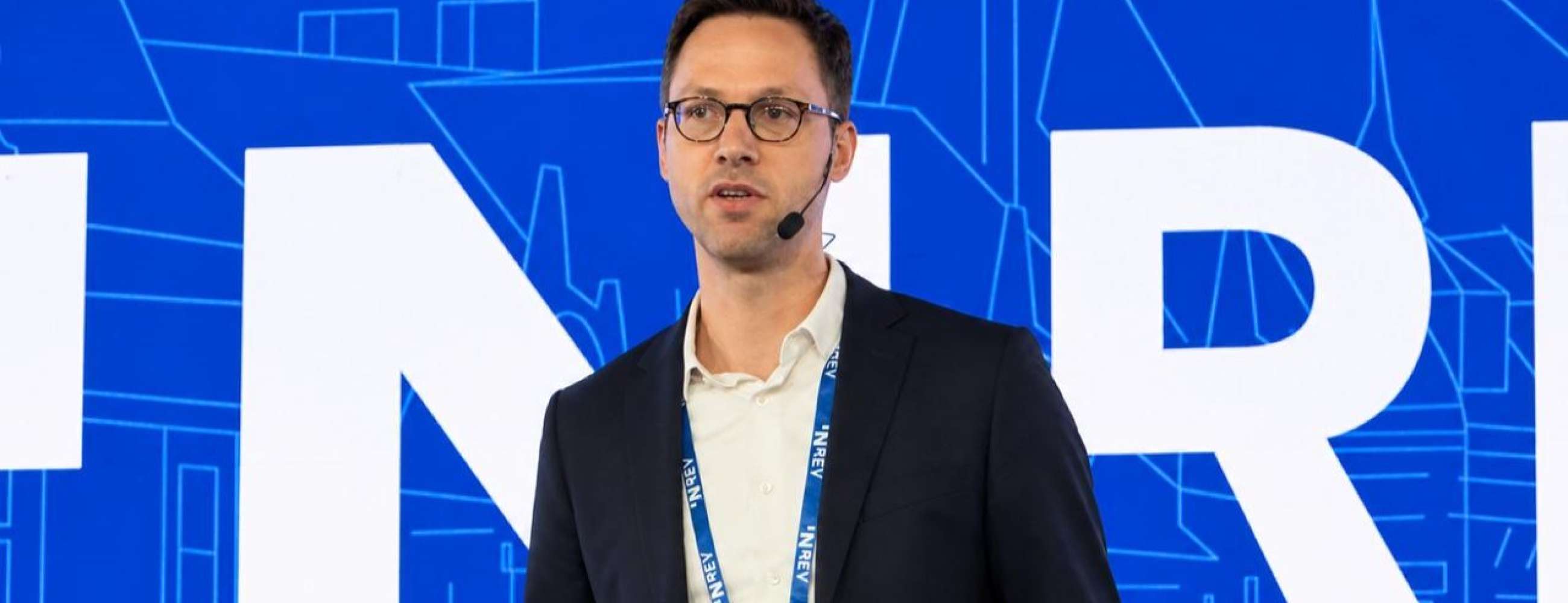
The conference opened with a keynote from Thijs van de Graaf, Associate Professor of International Politics at the Ghent Institute for International and European Studies, Ghent University, who explored how geopolitical tensions are reshaping the global energy landscape. Describing the current situation as the second major energy shock in four years, he highlighted how ongoing conflict has put around 20% of global oil exports at risk, exposing the continued vulnerability of international energy markets and supply chains.
Yet Thijs argued that these same pressures are accelerating the energy transition. Concerns around energy security, competitiveness and affordability are increasingly aligning with sustainability objectives, strengthening the case for electrification, energy efficiency and domestically produced energy. Renewables are now being viewed not only as climate solutions but also as tools to improve resilience and reduce dependence on volatile fossil fuel markets.
He pointed to the rapid decline in clean technology costs, noting that solar module prices have fallen by around 75% since 2022, while battery storage has also become increasingly affordable. However, the biggest challenge is no longer the availability of technology itself. With more than 2,500 GW of wind, solar and battery projects currently waiting for grid connections worldwide, electricity infrastructure is emerging as a major bottleneck to progress.
Looking ahead, Thijs stressed that the transition is not on autopilot. While clean technologies continue to improve and attract investment, long-term progress will depend on whether infrastructure, investment and policy can keep pace. His message set the tone for the discussions that followed: in a world of increasing uncertainty, sustainability, resilience and value creation are becoming ever more closely connected.
Audience poll:
Compared with 2022, how much cheaper were solar modules by 2025?
- About 10% - 6%
- About 25% - 19%
- About 40% - 32%
- About 55% - 22%
- About 75% - 15%
- About 90% - 6%
Looking at your real estate portfolios, which energy-related risk do you think is most underestimated today?
- Prolonged high and volatile energy prices - 15%
- Grid constraints and connection delays - 43%
- The cost of postponing building electrification - 12%
- Dependence on concentrated clean-technology supply chains - 1%
- Policy reversals and changing financial incentives - 13%
- Competition for electricity from data centres and AI - 15%
Changing real estate realities: sustainability as a driver of value (Maarten Jennen)

In the next session, Maarten Jennen, Senior Director, Strategist Private Real Estate, PGGM, challenged the way sustainability is still too often treated as a separate consideration in investment discussions. If sustainability affects value, he argued, it should be embedded in the core investment thesis rather than relegated to the final slides of an investment deck.
Setting this in the context of today's market, Maarten described a new environment shaped by higher interest rates, scarcer capital and ongoing disruption. As performance gaps between sectors narrow, he suggested that asset quality and active asset management are becoming increasingly important drivers of returns.
To assess opportunities, PGGM applies what Maarten described as a three-dimensional lens, evaluating investments through financial return, risk and sustainability. Rather than pursuing a single approach across all assets, the focus is on identifying the optimal balance for each investment based on factors such as sector, location and evolving market conditions.
Central to this is understanding how sustainability translates into financial performance. Maarten highlighted factors including energy and carbon efficiency, climate resilience, occupier demand and regulation, noting that these can influence net operating income and, ultimately, asset value. He also emphasised that the drivers of value vary across sectors, from employee experience in offices and electrification in logistics to affordability in residential assets and grid capacity challenges for data centres.
His message was clear: sustainability is increasingly becoming a defining component of asset quality. Looking ahead, he suggested that investors may be more likely to see a "brown discount" applied to less sustainable assets than a "green premium" awarded to higher-performing ones, creating opportunities for active managers who can enhance and future-proof their portfolios.
Audience poll:
Over the next 10 years, what will be the biggest sustainability-related driver of asset value?
- Regulation - 20%
- Energy/resource costs - 32%
- Physical climate risk - 20%
- Investor/lender requirements - 8%
- Occupier/customer preferences - 11%
- Technological change - 8%
The investor view: sustainability, risk and capital allocation (Constantin Sorlescu, Steve Goossens, Helen Gurfel and Wincel Kaufmann)
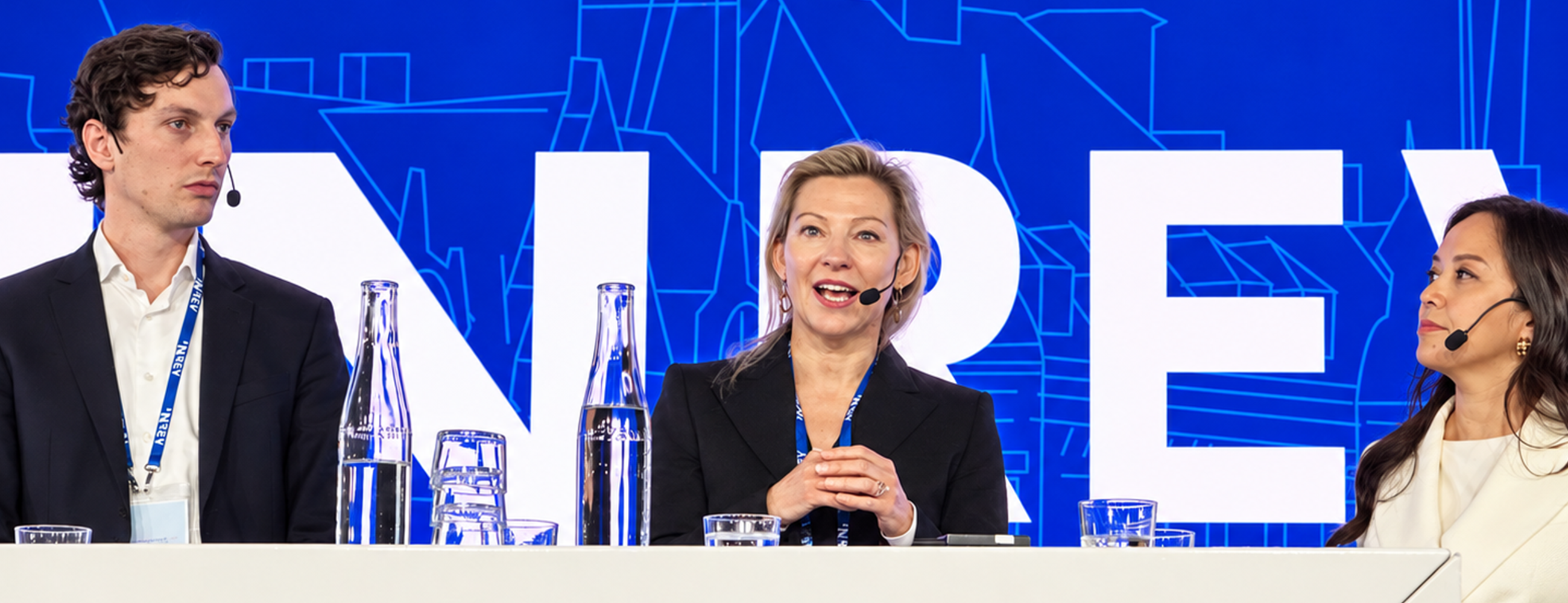
Moderated by Constantin Sorlescu, Director Professional Standards and Sustainability, INREV, this panel brought together Steve Goossens (APG Asset Management), Helen Gurfel (CBRE IM) and Wincel Kaufmann (Zurich Insurance) to explore how sustainability is increasingly being assessed through the same lens as other investment fundamentals, from risk and resilience to asset quality and returns. The discussion reflected a broader evolution in language and approach: from ESG as a separate concept, to sustainability, resilience and, ultimately, asset quality.
Steve Goossens reflected on the shift from backward-looking reporting to forward-looking decision-making, explaining how sustainability data are increasingly being used to steer portfolios and support investment strategy. He added that they are reviewing their reporting efforts to redirect resources towards measurable outcomes and asset-level action.
Helen Gurfel highlighted how geopolitical uncertainty and physical climate risks are accelerating this trend, pushing sustainability considerations further into mainstream investment teams as their impact on operating costs, resilience and performance becomes clearer. Energy security concerns are also indirectly driving decarbonisation through energy efficiency and electrification.
Wincel Kaufmann framed the discussion through the lens of asset quality, arguing that environmental, social and governance considerations are becoming an integral part of what defines a resilient, long-term investment. As investment teams take greater ownership of these issues, investors increasingly expect outcomes, not just goals.
The conversation also explored tangible links between sustainability and financial performance, with Helen pointing to distributed solar generation as a growing source of income across logistics portfolios, contributing up to 7% of net operating income in some cases. Better terms on sustainability-linked financing were cited as another example.
The panel also debated the concepts of a green premium and brown discount and discussed the growing importance of physical climate risk, which is not yet fully reflected in pricing.
The panel called for a more focused approach to sustainability data. While reporting remains necessary, the speakers agreed that the priority should be developing a smaller set of consistent, decision-useful metrics that can better support investment decisions. Looking ahead, they also highlighted AI's potential to reduce reporting burdens and free up resources for asset-level action and value creation.
Valuation and underwriting: the future of value (Shuen Chan, Aneta Rusiniak, Brett Ormrod)
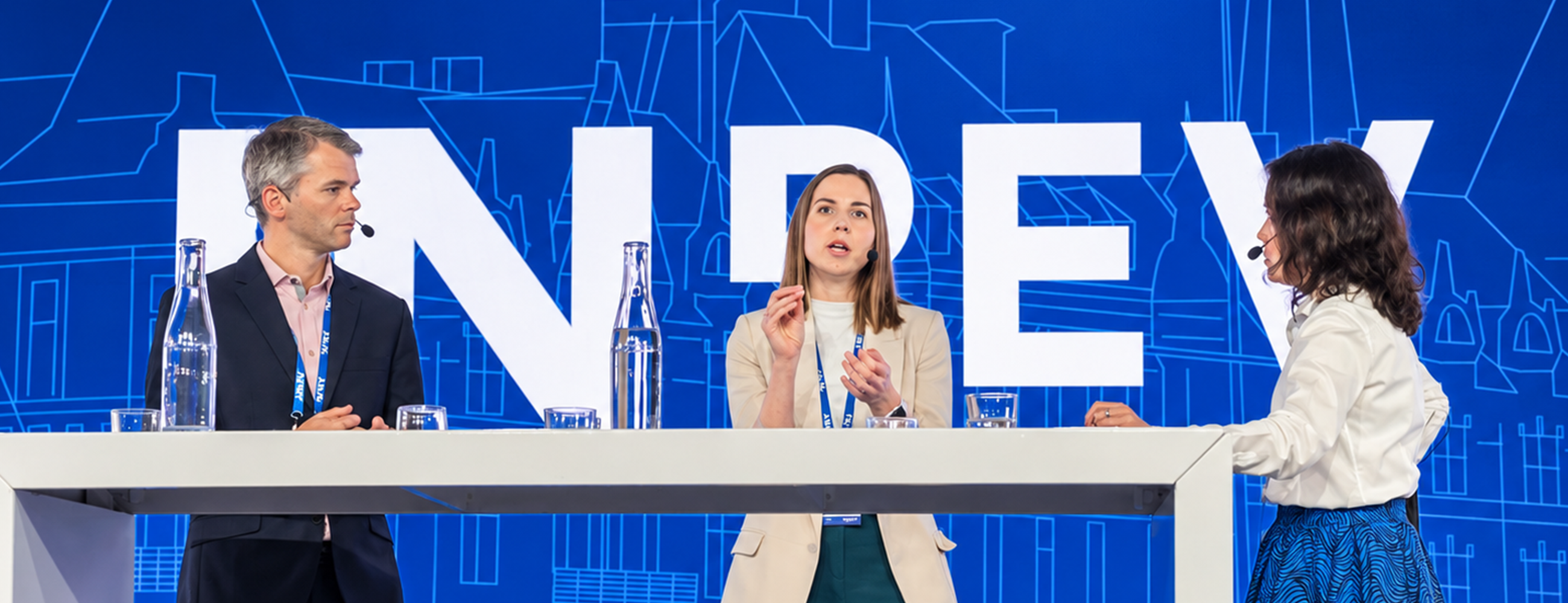
Moderated by Shuen Chan, this session brought together Aneta Rusiniak (Invesco) and Brett Ormrod (LaSalle Investment Management) to explore how sustainability is becoming embedded directly into underwriting and valuation processes. Both speakers agreed that sustainability is increasingly part of what defines a market-ready asset, shifting the conversation away from standalone ESG considerations towards income, costs, risk and long-term value.
Aneta Rusiniak outlined Invesco's market-readiness approach, which focuses on identifying the sustainability characteristics most relevant to each asset and taking practical steps to improve performance over time. While energy efficiency currently provides the clearest link to financial outcomes, she emphasised that sustainability is already being reflected in transactions where it is material. Citing a recent acquisition, she described how improving a building from EPC C to EPC B formed part of the deal itself, demonstrating how market expectations are evolving.
Building on this theme, Brett Ormrod argued that investors are increasingly assessing not only whether an asset is fit for today's market, but also what it will cost to keep it competitive in the future. Drawing on recent transactions in France and Poland, he showed how buyers are already pricing future decarbonisation requirements and sustainability-related liabilities into investment decisions, even before formal regulatory deadlines take effect.
The discussion highlighted how sustainability considerations are moving earlier in the investment process, alongside assessments of capital expenditure, energy consumption and exit risk. The speakers also noted that the implications vary by sector and strategy, from protecting occupancy and liquidity in offices to creating new income opportunities through solar generation, EV charging and battery storage in logistics.
A recurring theme was the need to move beyond broad sustainability labels and focus instead on the underlying data that influence future cash flows, operational performance and asset value. As the discussion concluded, both speakers emphasised that the challenge is no longer determining whether sustainability matters, but understanding how best to incorporate it into investment decision-making.
Physical climate risk: from data to decisions (Julie Townsend)
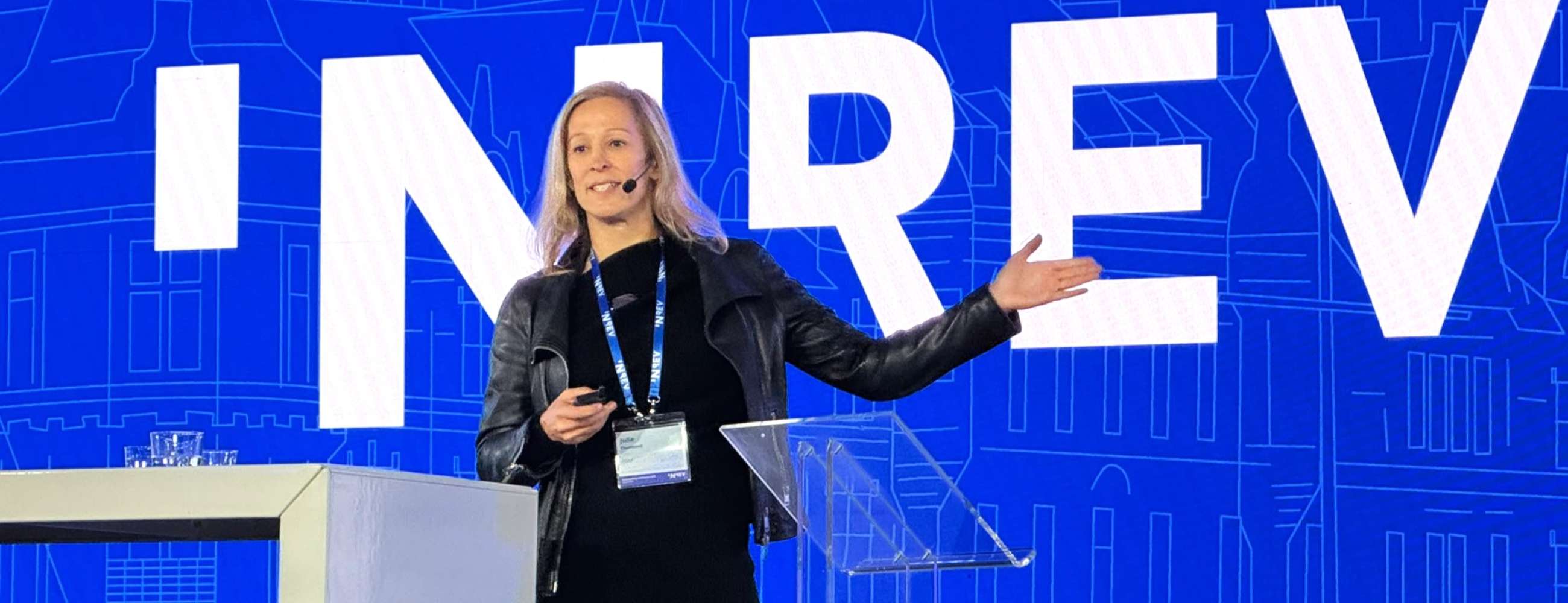
In a practical session on integrating climate risk into investment decision-making, Julie Townsend, Global Head of Sustainability, Real Estate, PGIM, explored how investors can move beyond high-level risk screening and translate physical climate risk into actionable decisions across acquisitions, asset management and valuation.
Julie argued that while physical climate risk is increasingly recognised as a material financial consideration, the industry still lacks a common methodology for assessing and comparing risks across assets and portfolios. Using flood risk as an example, she highlighted how the same climate event can have very different consequences depending on factors such as insurance coverage, resilience measures and an occupier's ability to recover operations quickly.
Drawing on real-world examples, Julie described how flood risk had directly affected asset values, including a UK industrial transaction where institutional investors withdrew from the bidding process. She also shared the example of an apart-hotel acquisition that PGIM chose not to pursue after detailed analysis identified multiple overlapping flood risks that could not be sufficiently mitigated.
A key theme throughout the session was the distinction between gross risk, based on the probability and severity of a climate event, and net risk, which considers the impact of adaptation measures and asset-level controls. Julie explained how PGIM uses a structured framework to assess both dimensions, helping investment teams determine what level of residual risk is acceptable and where additional capital investment may be required.
The discussion also emphasised that physical climate risk is ultimately about people as well as buildings. Alongside asset-level mitigation measures, Julie highlighted the importance of tenant engagement and emergency planning to improve resilience and support recovery when extreme weather events occur.
Her message was clear: understanding climate hazards is only the first step. The real challenge lies in consistently translating those risks into investment decisions, capital allocation and asset value.
Audience poll:
Have you seen evidence of physical climate risks presenting direct financial impacts at asset
level?
- Yes, with evidence from specific assets - 39%
- Yes, but the evidence is still emerging - 28%
- Not yet, but we are actively assessing this - 28%
- No, we don't see clear evidence of this at asset level - 5%
Have you been able to generate a climate value at risk, or similar financial risk metric, at platform or fund level?
- Yes, and we use it in investment or portfolio decisions - 19%
- Yes, but it is not yet used consistently in decision making - 33%
- Not yet, but work is in progress - 38%
- We do not believe CVaR or similar portfolio-level metrics are sufficiently useful for decision making - 10%
Oxford debate: Sustainability – transforming markets or losing the argument? (Shuen Chan, Andreas L. Farberg, Abigail Dean)
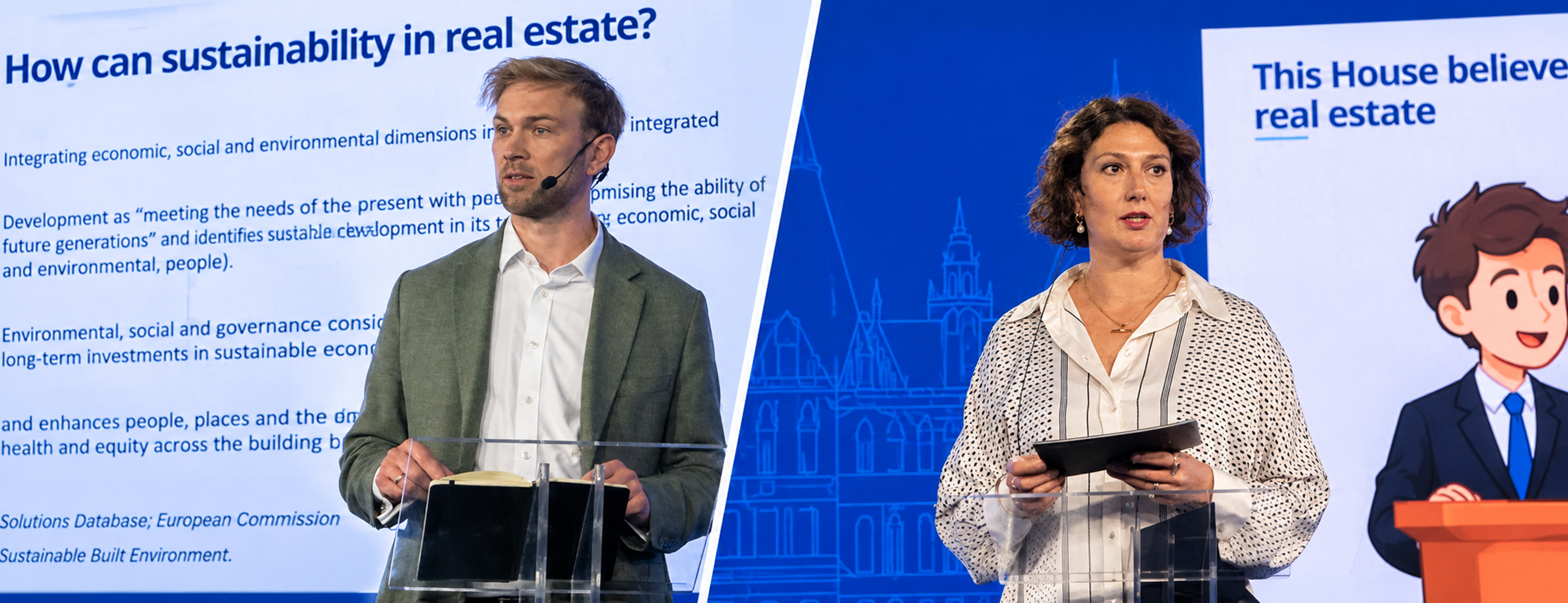
Moderated by Shuen Chan, this Oxford-style debate saw Abigail Dean (Nuveen) argue that sustainability is transforming value in real estate, while Andreas L. Farberg (KLP) challenged the proposition. The positions were assigned for the purposes of the debate and should not be read as the speakers' or their organisations' formal views.
Arguing in favour, Abigail pointed to growing evidence that sustainability is becoming an increasingly measurable and material driver of value. She highlighted research showing differences in rents, yields and vacancy rates between more and less sustainable buildings, as well as the growing integration of sustainability considerations into valuation guidance, underwriting and investment decision-making. She also cited practical examples from portfolios, including sustainability-linked financing, energy savings and additional income generated through technologies such as solar photovoltaics and EV charging.
Taking the opposing position, Andreas questioned whether sustainability itself is driving these changes. He argued that many of the outcomes attributed to sustainability are, in reality, the result of traditional market forces such as risk reduction, regulation, energy security and the pursuit of higher returns. He also challenged the evidence behind the so-called green premium, suggesting that greener buildings are often newer, better located or of higher quality, making it difficult to isolate sustainability as the determining factor.
The discussion ultimately centred on a fundamental question: is sustainability transforming how value is defined, or is the market simply adapting to new risks and economic realities? While the speakers disagreed on the drivers of change, both acknowledged that sustainability considerations are becoming increasingly embedded in investment processes, asset quality assessments and long-term value creation.
The debate offered a fitting reflection of one of the conference's central themes: as sustainability becomes more closely linked to performance, the conversation is shifting from whether it matters to how, and why, it influences value.
Audience poll:
This House believes sustainability is transforming value in real estate.
Before the debate:
- For the motion - 74%
- Against the motion - 26%
After the debate:
- For the motion - 47%
- Against the motion – 53%
From intent to impact: measuring social value (John Levy)
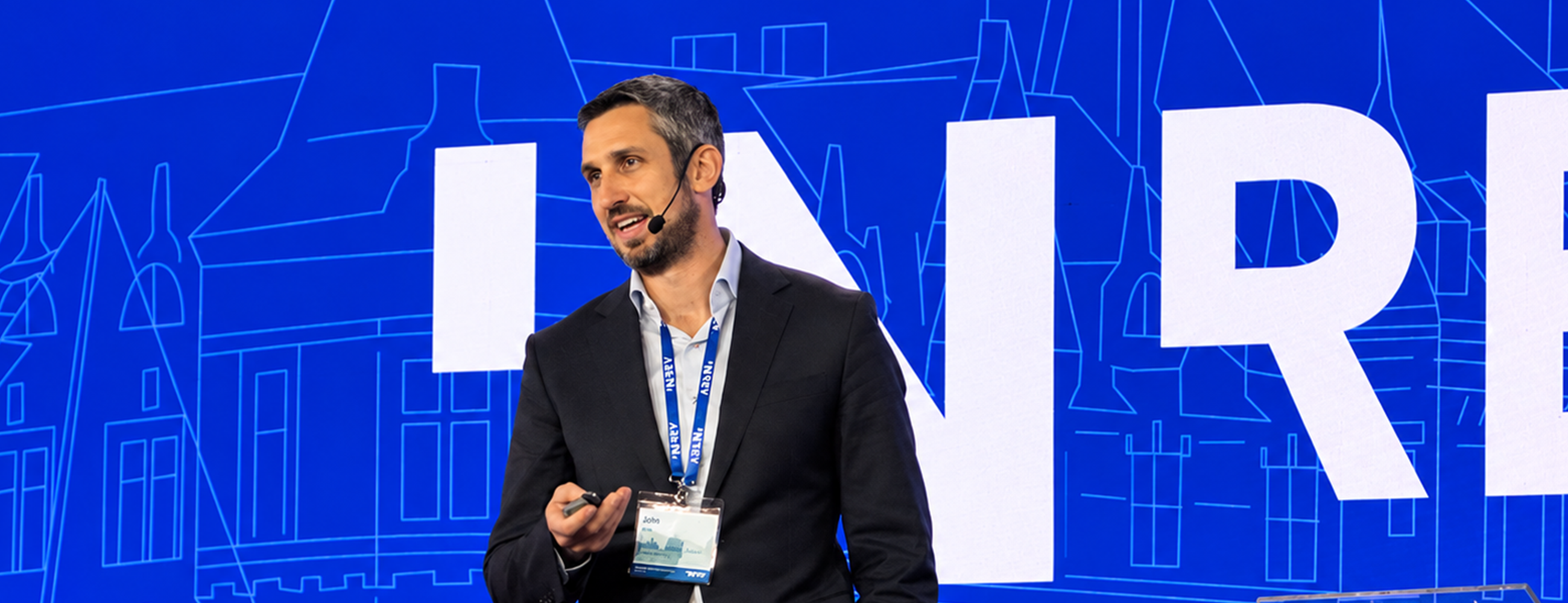
Shifting the focus from environmental issues to the social dimension of sustainability, John Levy, Managing Director Impact, Franklin Real Asset Advisors, explored how social value can contribute to both community outcomes and investment performance. He argued that social value is often overlooked in real estate despite being fundamental to how buildings and places support the people who use them.
A key theme of the session was the distinction between social value and social impact. While social value can exist whether or not it is intentionally measured, John explained that social impact requires a more deliberate approach, supported by evidence and clear objectives. Investors do not need to identify as impact investors, he argued, to recognise and capture the value that social outcomes can create.
John outlined several pathways through which social attributes can influence financial performance. Factors such as health and wellbeing, access to housing and services, community engagement and urban regeneration can strengthen tenant demand, improve income stability, reduce risk and support long-term asset value.
Drawing on a series of case studies, he demonstrated how these connections play out in practice. One example focused on a UK care-home portfolio, where improvements to asset quality and operational performance reduced risk and supported valuation. Another highlighted a London office refurbishment that prioritised occupier health and wellbeing, helping secure a record pre-let rent that more than justified the additional investment.
John also pointed to mid-market housing as an area where social and financial value can reinforce one another, benefiting from strong and resilient demand across market cycles. He concluded by encouraging investors to view social value as part of overall asset quality rather than as a separate sustainability category, arguing that measurement should support action rather than delay it.
The power of storytelling: making a drama out of the climate crisis (Joe Murphy and Joe Robertson)
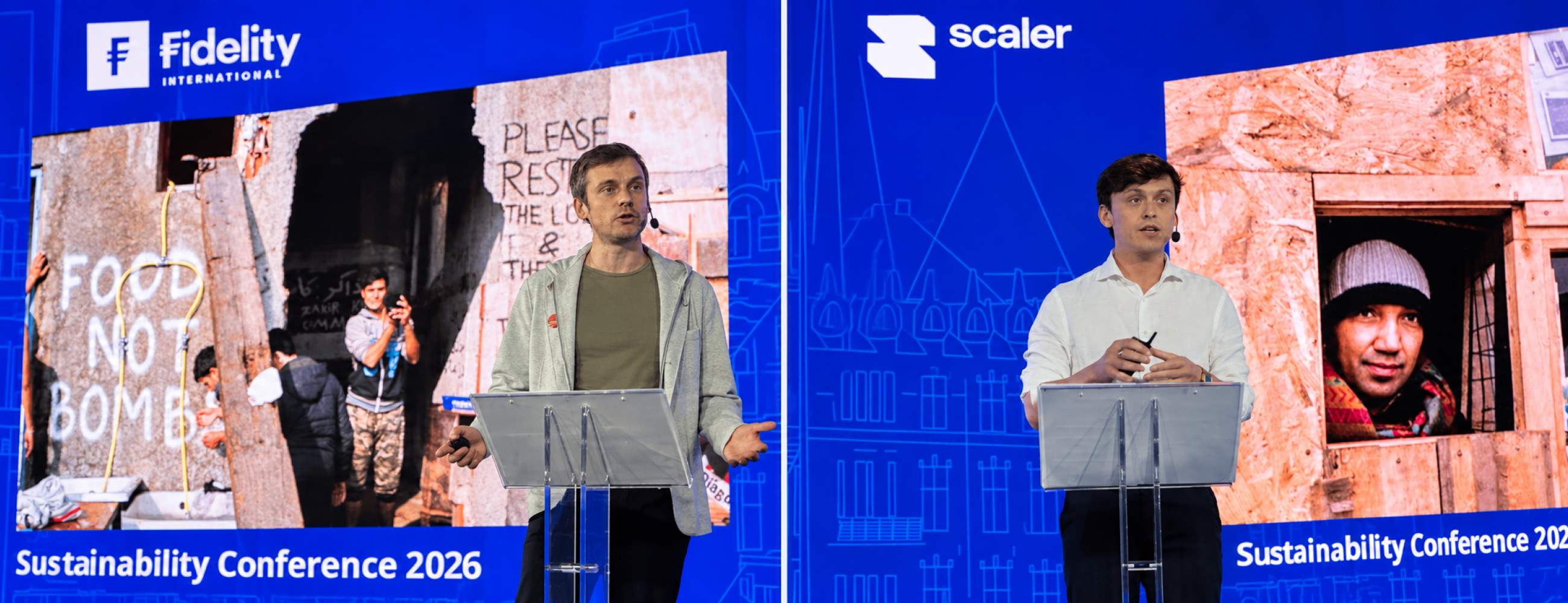
Closing the conference on a different note, Joe Murphy and Joe Robertson, Co-Founders of Good Chance, explored the role of storytelling, conversation and empathy in addressing complex global challenges. Drawing on their experiences as playwrights and theatre-makers, they argued that meaningful change often begins not with data or policy, but with the ability to help people understand perspectives beyond their own.
The pair reflected on the origins of Good Chance during the European refugee crisis, when visits to the Calais Jungle challenged their preconceptions and revealed a much more complex and human reality than that portrayed in much of the public debate. This experience led to the creation of the Good Chance Theatre, a shared space designed to bring together people from different cultures and backgrounds through conversation, creativity and performance.
They went on to discuss a number of projects built around the idea of fostering understanding through storytelling, including The Jungle, an immersive play based on life in the refugee camp, and The Walk of Little Amal, which followed the journey of a giant puppet representing a young Syrian refugee across multiple countries and communities.
Turning to the climate crisis, Murphy and Robertson shared insights from their latest production, Kyoto, which dramatises the negotiations that led to the Kyoto Protocol. Rather than presenting climate change as a technical or scientific debate, the play places audiences around the negotiating table, encouraging them to engage with different viewpoints and the realities of compromise, disagreement and diplomacy.
Throughout the session, the speakers highlighted the importance of preserving dialogue in an increasingly polarised world. Their closing message resonated strongly with the conference theme: progress depends not only on data, targets and frameworks, but also on the willingness to listen, understand different perspectives and continue the conversation.
Presentations
Photos
Thank you to our sponsors